Ha Giang Loop Motorbike Guide: Rental, Routes & Tips
The complete guide to riding the Ha Giang loop by motorbike — route options, where to rent, permits, best time to go, accommodation, and everything you need for Vietnam's most epic ride.
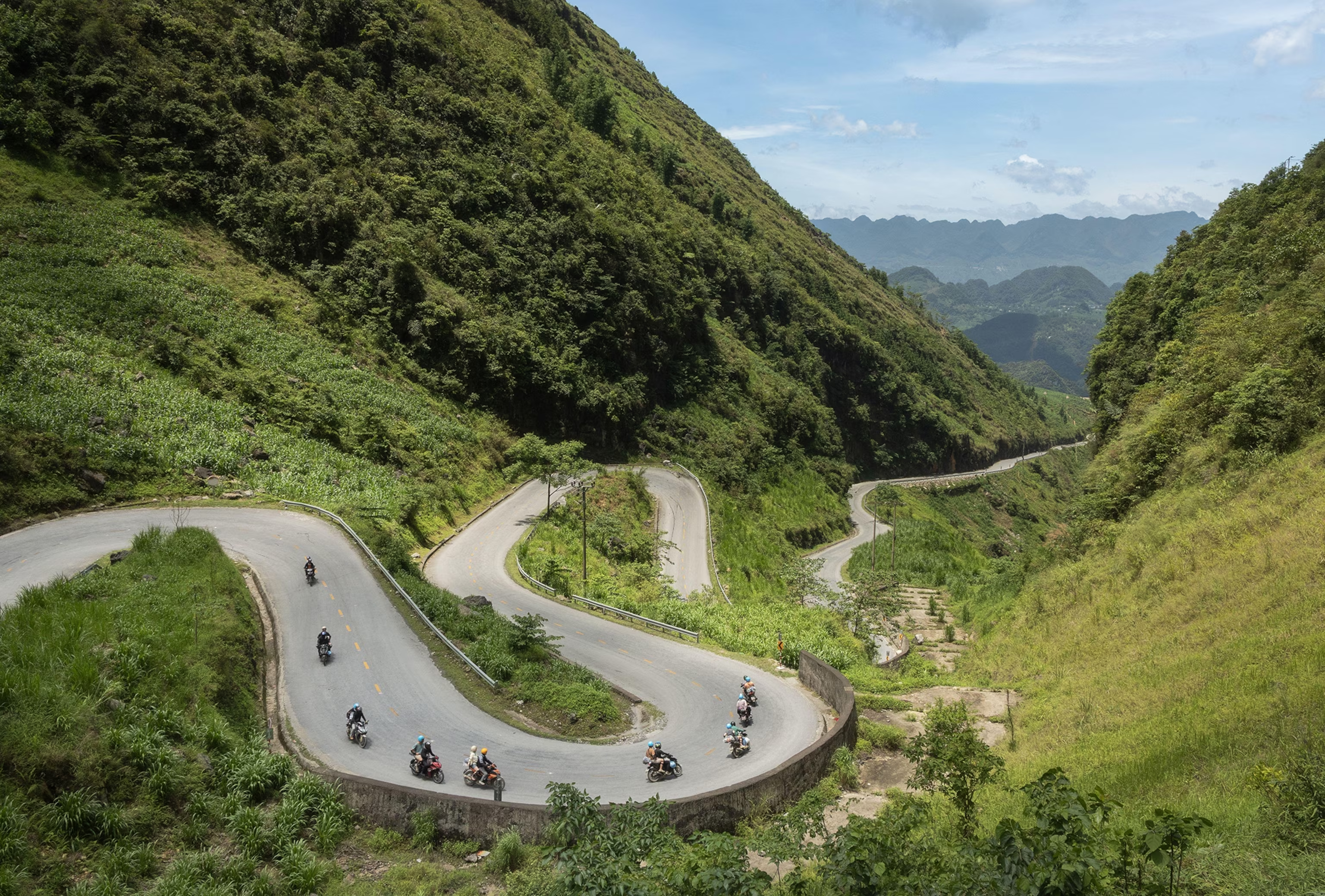
Why the Ha Giang loop is Vietnam's greatest ride
If you ride a motorbike in Vietnam and skip Ha Giang, you've missed the main event. The Ha Giang loop is a 350 km circuit through the northernmost province of Vietnam — a landscape so dramatic that UNESCO designated it a Global Geopark. Towering limestone karsts, terraced rice paddies carved into impossibly steep mountainsides, winding roads cut into cliff faces, and ethnic minority villages that feel untouched by time.
This isn't a casual day trip. It's 3–4 days of mountain riding through some of the most spectacular scenery in Southeast Asia. The roads are challenging, the altitude changes are constant, and the views will make you pull over every 10 minutes.
It's also, unquestionably, the highlight of most people's time in Vietnam.
The route: 3-day vs 4-day loop
The Ha Giang loop starts and ends in Ha Giang City, the provincial capital. There are two main route options:
3-day loop (standard)
| Day | Route | Distance | Highlights |
|---|---|---|---|
| Day 1 | Ha Giang → Yen Minh → Dong Van | ~150 km | Quan Ba Twin Mountains, Yen Minh pine forests, Lung Cu flag tower detour |
| Day 2 | Dong Van → Ma Pi Leng Pass → Meo Vac | ~90 km | Dong Van old quarter, Ma Pi Leng Pass, Tu San Canyon, Nho Que River |
| Day 3 | Meo Vac → Du Gia → Ha Giang | ~150 km | Du Gia waterfall, rice terraces, Bac Sum Pass |
4-day loop (recommended)
Same route but split more comfortably:
| Day | Route | Distance | Overnight |
|---|---|---|---|
| Day 1 | Ha Giang → Quan Ba → Yen Minh | ~100 km | Yen Minh |
| Day 2 | Yen Minh → Lung Cu → Dong Van | ~80 km | Dong Van |
| Day 3 | Dong Van → Ma Pi Leng → Meo Vac | ~25 km | Meo Vac |
| Day 4 | Meo Vac → Du Gia → Ha Giang | ~150 km | Ha Giang |
Our recommendation: Take 4 days. Day 3 on the 4-day itinerary is only 25 km, which gives you the entire day to ride the Ma Pi Leng Pass slowly, stop at viewpoints, hike down to the Nho Que River, and explore Meo Vac's Sunday market (if your timing is right).
When to go
Best months: September–November
This is peak season for good reason. The rice terraces are golden and ready for harvest (September–October), the skies are usually clear, and temperatures are comfortable (15–25°C during the day).
October is the single best month — golden rice terraces, minimal rain, and perfect riding temperatures.
Also good: March–May
Spring brings blooming flowers (buckwheat flowers in November are famous, but plum and peach blossoms appear in March). The terraces are green and lush. Less crowded than autumn.
Avoid: June–August
Monsoon season. Heavy rain, fog, landslides, and dangerously slippery roads. Some sections may be impassable. Not worth the risk.
Avoid: December–February
Cold, foggy, and sometimes near-freezing at altitude. Visibility can drop to near zero on mountain passes. If you do go, bring serious cold-weather gear.
Which bike for Ha Giang?
This is the most important decision you'll make. Ha Giang's roads include steep mountain passes, sharp switchbacks, loose gravel sections, and occasional unpaved detours.
Kawasaki Versys-X 300 — the Ha Giang pick
The Versys-X 300 is built for exactly this kind of riding. Its 296cc parallel-twin delivers 40 HP — more than enough muscle for Ha Giang's steep passes — while staying relatively light at 184 kg. High riding position, adventure suspension for rough patches, and a 17L tank that gets 3L/100km so you won't be sweating fuel stops. It's our top recommendation for the loop.
Pros: Strong power-to-weight ratio, long-travel suspension handles loose gravel well, efficient enough for remote riding. Cons: 815 mm seat height may challenge shorter riders; a bigger bike than most travellers are used to.
Honda CB500X 2022 — the premium option
For experienced riders who want zero stress on the ascents, the CB500X's 471cc parallel-twin with 46.9 HP is effortless on every climb. Heavier at 199 kg, but the 830 mm seat and long-travel suspension make it the most comfortable bike over four days of mountain riding. The 17.5L tank gives you the longest range on the loop.
Pros: Outstanding power, confidence-inspiring brakes, maximum comfort on long riding days. Cons: Heaviest option at 199 kg — requires confident bike-handling skills.
Honda Winner X — the upgrade pick
More power (150cc liquid-cooled), smoother transmission, and a sportier feel. Handles Ha Giang roads well if you're comfortable with a manual bike. Better for taller/heavier riders.
Pros: More refined engine, better braking, comfortable for experienced riders. Cons: Heavier, lower ground clearance than XR150, less forgiving on rough terrain.
Honda Wave / Blade — budget option
Some riders do Ha Giang on a semi-automatic Wave or Blade. It works, but the underpowered engine (110cc) struggles on steep passes, and you'll be riding at full throttle more often than you'd like.
Pros: Cheap, extremely fuel-efficient, easy to ride. Cons: Underpowered for steep grades, uncomfortable on long days.
What NOT to ride
Scooters (Honda Vision, Lead, etc.): The small wheels, low ground clearance, and CVT transmission make scooters genuinely dangerous on Ha Giang's mountain roads. Loose gravel + small wheels + steep downhill = bad time. Don't do it.
Where to rent
Option 1: Rent in Hanoi and ride to Ha Giang
Hanoi is 300 km south of Ha Giang City (6–7 hours by bike). Many travellers rent from a Hanoi shop and ride the QL2 highway north. This gives you the most flexibility and usually better prices.
Option 2: Rent in Ha Giang City
If you want to skip the highway ride, take a sleeper bus from Hanoi to Ha Giang (6–8 hours, ~200,000 VND) and rent locally. Ha Giang City has plenty of rental shops along the main street.
Option 3: Rent from Ho Chi Minh City
At 247 Motorbikes, we can arrange one-way rentals — pick up a Versys-X 300 or CB500X in HCMC and fly it to Hanoi via our transport service. Contact us for details.
Peak season note: Expect higher prices in October and November. Book ahead if possible — adventure bikes in particular get snapped up fast. Browse our fleet for current availability.
The permit question
Ha Giang province requires a travel permit for foreigners visiting certain border areas. Your accommodation in Ha Giang City can arrange this for you — it typically costs 50,000–100,000 VND and takes 30 minutes to process.
What you need:
- Passport (original)
- Passport photo (some places can take one)
- The fee
Get this sorted the afternoon/evening before you start the loop. Most hostels handle the entire process.
Road conditions and difficulty
Let's be honest about what you're getting into:
The good
- The main loop road (QL4C) is paved and in decent condition for most of its length.
- Signage has improved significantly — you won't get lost if you follow the main road.
- Fuel stations exist in every town (Yen Minh, Dong Van, Meo Vac).
The challenging
- Steep gradients: Some passes have 15–20% grades. Your engine will work hard.
- Switchbacks: Tight hairpin turns on narrow mountain roads with drop-offs. Stay in your lane.
- Loose surfaces: Short gravel and dirt sections appear, especially after rain or road maintenance.
- Other traffic: Trucks, buses, livestock, children, and other motorbikes share the road. Assume every blind corner hides something.
- Weather changes fast: You can ride from sunshine into thick fog in 5 minutes at altitude.
The Ma Pi Leng Pass
The highlight of the loop — and the most demanding section. A 20 km stretch of road carved into a cliff face 1,500 meters above the Nho Que River. The views are staggering. The road is narrow, winding, and has sheer drops on one side.
Tips for Ma Pi Leng:
- Ride it in the morning for the best light and least fog.
- Go slow. This is not the place to rush.
- Pull over at every viewpoint. You won't regret it.
- Watch for oncoming traffic on blind corners — honk before every turn.
What to pack
Essential
- Full-face helmet (bring your own or rent a good one — don't rely on cheap ones from rental shops)
- Riding gloves — your hands will freeze on morning descents
- Rain gear — even in dry season, mountain weather is unpredictable
- Warm layers — temperatures drop to 10–15°C at altitude, colder in winter
- Sunscreen and sunglasses — UV is intense at altitude
- Phone mount and offline maps — download the Ha Giang area on Google Maps before you leave
- Cash — ATMs exist in Ha Giang City but are unreliable in Dong Van and Meo Vac. Bring enough for 4 days (2,000,000–3,000,000 VND should be plenty)
Recommended
- Bungee cords or straps for securing bags
- Basic first aid kit
- Portable phone charger
- Camera (your phone will run out of storage)
Accommodation on the loop
Accommodation is basic but widely available. Every stop on the loop has guesthouses and homestays ranging from 100,000–300,000 VND per night.
Recommended stops
Yen Minh: Small town with a few guesthouses. Quiet overnight.
Dong Van: The best base on the loop. The old quarter has character, and there are several good homestays and hostels. This is where most riders spend their best evening — cold beers on a rooftop watching the sun set over the karsts.
Meo Vac: Growing traveller hub with decent accommodation. If you time it right, the Sunday morning market is one of the most authentic ethnic minority markets in Vietnam.
Budget breakdown (4-day loop)
The Ha Giang loop is remarkably affordable. Your main costs are bike rental, fuel (~15 liters total), accommodation for 3 nights, food, and the travel permit. That's right — one of the world's greatest motorbike rides costs less than a nice dinner in most Western cities.
Safety tips specific to Ha Giang
- Don't ride at night. Mountain roads with no lighting, no guardrails, and livestock on the road. Just don't.
- Check your brakes daily. You'll use them heavily on descents. If they feel soft, get them adjusted in the next town.
- Carry your permit. Police checkpoints exist, especially near Lung Cu (the northernmost point near the Chinese border).
- Watch your fuel. Fill up in every town. The longest stretch without fuel is Dong Van to Meo Vac (~25 km on the short route, but don't assume the station is open).
- Ride your own ride. Don't try to keep up with more experienced riders. The views are the same at 30 km/h.
Getting to Ha Giang
From Hanoi
- Sleeper bus: 6–8 hours, departing from My Dinh bus station. ~200,000–300,000 VND. Multiple daily departures.
- Motorbike: 300 km on QL2. 6–7 hours. The highway section is flat and straightforward.
From Ho Chi Minh City
- Fly to Hanoi (2 hours, from 1,000,000 VND one way), then bus or ride to Ha Giang.
- We offer motorbike transport between cities if you want to bring your rental bike.
Frequently asked questions
Can a beginner ride the Ha Giang loop? It depends on your definition of beginner. If you've never ridden a motorbike before, Ha Giang is not the place to learn. Get comfortable riding in a city first. If you can handle a manual bike and are confident on hills, you'll be fine — just take it slow.
Do I need a guide or can I go solo? You don't need a guide. The route is well-established, signposted, and thousands of travellers ride it independently every year. However, a local guide can add cultural context and take you to spots you'd never find alone.
Is it safe to ride alone? Yes, many solo travellers ride the loop. You'll meet other riders at every stop. The main risk is mechanical breakdown in a remote area — carry a phone with signal (Viettel has the best mountain coverage) and your rental shop's number.
What if it rains? Light rain is manageable with rain gear. Heavy rain on mountain roads is dangerous — pull over and wait it out in a café. In monsoon season (June–August), extended rain can cause landslides that close roads for days.
Can I do the loop on an automatic scooter? We strongly advise against it. The small wheels and low ground clearance make scooters unsafe on loose mountain roads. Rent a Versys-X 300 or CB500X instead.
Related articles
Vietnam-Laos Border Crossing by Motorbike
Everything you need to know about crossing the Vietnam-Laos border with a motorbike — which crossings work, required documents, current restrictions, and practical tips for 2026.
Route GuideDa Nang to Hoi An by Motorbike: Rental & Route Guide
How to ride from Da Nang to Hoi An by motorbike — the best route via the coast or countryside, rental options, the Hai Van Pass detour, and tips for exploring Central Vietnam on two wheels.